
You are using an out of date browser. It may not display this or other websites correctly.
You should upgrade or use an alternative browser.
You should upgrade or use an alternative browser.
LAC Vol.1 Dance Your Cares Away/Fraggle/Law Abiding Citizens
- Thread starter Bryan74b
- Start date
Law Abiding Citizens volume 1.
- Status
- Not open for further replies.

I have a friend that works with the fb eye he had the opportunity to redact the Epstein files for a great pay of overtime. He didn’t do it but said all the people that did had to sign stuff that they could never reveal what they seen are read. He did say that anything you have ever read or imagined is in there. It’s all true.
I ask when the arrest would start and he said he didn’t know because it would literally take our government out. Said it’s almost one of those deals that the government is to big to fell. Kind of like the banks back in 08 or 09.
I told him that was bullshit that those pieces of shit need to go down.
I’ve been knowing this the first of the year but just now posting it. I so hope he is wrong about they cannot go down.
Said Trump has been trying to be nicer this go around to try and get what needs to be done. Our government is the most corrupted pieces of shit in the world and it’s not even close.
Hopefully Q is in place and the patriots win. That’s all I got for now.
I ask when the arrest would start and he said he didn’t know because it would literally take our government out. Said it’s almost one of those deals that the government is to big to fell. Kind of like the banks back in 08 or 09.
I told him that was bullshit that those pieces of shit need to go down.
I’ve been knowing this the first of the year but just now posting it. I so hope he is wrong about they cannot go down.
Said Trump has been trying to be nicer this go around to try and get what needs to be done. Our government is the most corrupted pieces of shit in the world and it’s not even close.
Hopefully Q is in place and the patriots win. That’s all I got for now.
That’s unfortunateI have a friend that works with the fb eye he had the opportunity to redact the Epstein files for a great pay of overtime. He didn’t do it but said all the people that did had to sign stuff that they could never reveal what they seen are read. He did say that anything you have ever read or imagined is in there. It’s all true.
I ask when the arrest would start and he said he didn’t know because it would literally take our government out. Said it’s almost one of those deals that the government is to big to fell. Kind of like the banks back in 08 or 09.
I told him that was bullshit that those pieces of shit need to go down.
I’ve been knowing this the first of the year but just now posting it. I so hope he is wrong about they cannot go down.
Said Trump has been trying to be nicer this go around to try and get what needs to be done. Our government is the most corrupted pieces of shit in the world and it’s not even close.
Hopefully Q is in place and the patriots win. That’s all I got for now.
But if the right people can use it to blackmail and win back this country..that would be okayThat’s unfortunate


Self aware & aware of us
Dangerous AF
Dangerous AF

Calm down, we got this.
Right now, we are at war. Stay frosty! More disclosure- inbound!

There’s other ways.I have a friend that works with the fb eye he had the opportunity to redact the Epstein files for a great pay of overtime. He didn’t do it but said all the people that did had to sign stuff that they could never reveal what they seen are read. He did say that anything you have ever read or imagined is in there. It’s all true.
I ask when the arrest would start and he said he didn’t know because it would literally take our government out. Said it’s almost one of those deals that the government is to big to fell. Kind of like the banks back in 08 or 09.
I told him that was bullshit that those pieces of shit need to go down.
I’ve been knowing this the first of the year but just now posting it. I so hope he is wrong about they cannot go down.
Said Trump has been trying to be nicer this go around to try and get what needs to be done. Our government is the most corrupted pieces of shit in the world and it’s not even close.
Hopefully Q is in place and the patriots win. That’s all I got for now.
Court of public opinion is standing up and getting pissed.
Remember Q told us they wouldn’t be able to walk the streets.

They should announce that Seattle will be free of ICE enforcement as we focus on other areas of the country. They will be flooded with fleeing immigrants from other states. Once we clean up the rest send all ICE agents to Seattle for mop up duty.

Jim, spare us the performative hysteria. Your "colleague and friend" Don Lemon isn't a martyr for the First Amendment...he's a federal defendant because he crossed the bright red line from journalism into criminal conspiracy.
He didn't "report" on that Minnesota church disruption. He embedded himself with the mob, livestreamed their invasion of a house of worship, and participated in terrorizing families and children mid-service. That's not fucking press freedom, Jim. That's 18 U.S.C. § 241...conspiracy to deprive American citizens of their constitutional right to free exercise of religion. Maximum ten years. Add the FACE Act protections for places of worship, and the case writes itself.
The First Amendment shields reporters, not rioters masquerading as reporters. Lemon wasn't observing; he was orchestrating chaos. When you storm a sanctuary, confront worshippers, and intimidate congregants, you forfeit any claim to journalistic immunity. Courts have been crystal clear for decades: the press pass isn't a license to commit crimes.
This arrest will stand.
The evidence is overwhelming, the law is unambiguous, and the judiciary isn't populated by the activist clowns you prefer. Don is fucked, comprehensively and irrevocably, because he chose activism over ethics and terrorism over truth.
Your tears won't save him. The Constitution you pretend to defend just bit him in the ass...and it was long overdue.
Sit the fuck down, Jim. Permanently.
GPS—Minneapolis, Minnesota, protests today, Friday, January 30, 2026. Without revealing proprietary technology, tactics, and methods, understand that if someone uses a Faraday bag or even leaves their device at home, we can still reconcile their likely movements and location.
In fact, it's after dispersal that the real data exploitation begins.
When a large protest happens—especially one that isn’t institutionally approved—you can always assume it’s being mapped in real time by every intelligence and policing network with overlap to that jurisdiction. They don’t “watch” in the traditional sense; they analyze systems. The modern apparatus doesn’t care about shouting crowds; it cares about data signatures.
Every phone becomes a tracker beacon.
Even if “location off” is toggled, the phone still emits continuous metadata:
Cell-tower handoffs (triangulation gives position within meters)
Wi‑Fi pings (routers log MAC addresses)
Bluetooth scans and proximity signalsI
MSI catchers (“Stingrays”) mimic cell towers, forcing all nearby phones to connect. That gives agencies mass identifier lists and movement paths.
Device fingerprinting: once a phone’s radio signature is logged, it can be matched later even with a new SIM.
License‑plate readers (ALPRs) tie individuals’ physical locations to digital ones
All of this gets piped into fusion centers, where predictive models weigh “social stability indexes” and generate risk ratings on protesters.
Before, during, and after demonstrations, my team and I rely on automated social-media ingestion.
Pattern mapping: bots scan hashtags, Telegram channels, Discord groups, Signal, and even “private” messaging servers that leak metadata.
Sentiment clustering: AI classifies users as organizers, participants, sympathizers, or hostile observers.
Social‑graph scoring: once a few key IDs are confirmed, algorithms find second‑ and third‑degree ties—family, employer, affiliations.
That’s how protests get “pre‑neutralized.” Not by arrests, but by psychological operations: deplatforming, malware, intimidation messages, or pressure on employers to deter attendance.
Even if data is encrypted end‑to‑end, traffic analysis (who talks to whom, when) exposes networks and leads to the identification of each user.
The crowds marching through downtown Minneapolis on January 30, 2026, against ICE deportations and enforcement actions (as part of the nationwide "economic blackout" or National Shutdown) are primarily local residents from the Twin Cities metropolitan area, including Minneapolis and St. Paul, with strong participation from Minnesota-based community members.
Key groups and demographics in the crowd include:
Labor unions and workers — Significant involvement from unions like the Minneapolis Regional Labor Federation (AFL-CIO), Service Employees International Union (SEIU), American Federation of State, County, and Municipal Employees (AFSCME), Communications Workers of America, and others.
University of Minnesota student groups (including Black- and Somali-led organizations), along with students from walkouts at local schools and campuses.
Groups such as COPAL (Comunidades Organizando el Poder y la Acción Latina),
TakeAction Minnesota,
Minnesota Immigrant Rights Action Committee (MIRAC),
Immigrant Law Center of Minnesota, and faith-based coalitions like the Minnesota Interfaith Coalition on Immigration (ICOM) and ISAIAH MN were present. Participation from national and local entities included 50501, CodePink, Defend Immigrant Families Campaign, Council on American-Islamic Relations (CAIR), Palestinian Youth Movement, and socialist-leaning groups (e.g., Twin Cities DSA, Party for Socialism and Liberation). Clergy, faith leaders, and neighborhood rapid response networks were also present.
Data analysis combined with CCTV feeds shows a mix of families (including parents with kids), teachers, nurses, social workers, clergy, activists, and residents from various backgrounds.
Interesting, there were at least 100 of these little beauties in the crowd. "Flipper Zero" is still the most iconic "pocket multi-tool" in 2026. Sub-GHz, RFID/NFC, IR, iButton, GPIO, BadUSB emulation.
Huge community, custom firmwares (Unleashed, RogueMaster, Xtreme). It's the gadget that non-hackers recognize as "hacker stuff" and many actual pentesters carry one.
WOW! TIMING IS EVERYTHING!!
DOJ Releases 3 Million Pages Of Epstein Files
The world's Largest Bank, the World's Largest Derivative Holder & the World's Largest Silver RIGGER can be found in 62,756 documents related to the Epstein Files!!
Not only that but JAMIE DIMON is in 276 documents INCLUDING personal emails back and forth with Epstein in 2013 AFTER he testified, under oath, that he didn't even know Epstein!!
See for yourselves with a search of JPMorgan or Jamie Dimon!!https://justice.gov/epstein
THIS IS THE LAST PIECE OF THE PUZZLE THAT JENNY MOONSTONE WAS TALKING ABOUT WHEN SHE SAID "SILVER WILL NOT BE FREED UNTIL THE EPSTEIN PEDOPHILE RING IS REVEALED TO THE PUBLIC!"
This is amazing stuff...VERY SCARY but AMAZING!!
Make your FINAL PREPARATIONS!
One of the defining, unstated philosophies of Democrats in the modern era can be understood as follows:
If a Democrat breaks the law in furtherance of a cause that Democrat personally believes to be just, such Democrat did not break the law.
Pretty much every major news story of the past few weeks has been based in this belief--see, e.g., Don Lemon, Alex Pretti, Renee Good and every other Democrat domestic terrorist violating numerous federal, state and local criminal statutes.
New report from the Federal Communications Commission, Inspector General finds the state of California approved free phone and internet service for more than 94,000 dead people
81% of the fraud nationwide for this program comes from California“
California misused $3.8 million in federal funds meant for low income Americans so that deceased Americans could have free internet. Of all the fraud found in this program, 81% came from California. Due to our state's proven lack of management and leadership expertise, the FCC has now revoked California's authority to manage this program”“Your tax dollars at work, folks”
Found Ghislaine's bank statements in the Epstein Files and it really looks like they were using boat rentals from a known Disney Cruise line stop at Epstein Island called Captain Nautica Snorkeling Expedition to traffick children.
Disney Cruise Lines stop here. It's on their itinerary.
If you look at the statement there's a drug store purchase on the 28th. A flight from Epstein Island to NY on the 29th. A boat rental from a known Disney Cruise line stop, and then another flight from the Island to NY.
The passengers names are redacted most likely due to them being victims.
We spotlighted Captain Nautica Disney Cruise stop in the past for possible trafficking operations by children on Cruise ships. I'd like to know if a Disney Cruise ship arrived there on the 29th of 06' or around that timeframe.
Earlier this year, after the new administration took office, the Taliban openly expressed concern in a meeting that Congress would defund them. The State Department literally assured them not to worry that if Congress cut the funding, they would just send the Taliban the funds by routing it through the World Bank as cover.
We are heading into a direct confrontation with corruption inside our own government, and we are not backing down. These officials are knowingly financing a pipeline of future terrorist attacks against Americans, prioritizing backroom deals over U.S. national security.

PAID AND ORGANIZED PROTEST caught on camera Protest organizers are caught loading up their supplies after the protest finished 3 large organizations are on the ground all working together to create the protest. Some funded by foreign billionaires
David Khait “If you've ever wondered how protests happen on the spot, this is exactly how:
— Right now what they're doing is they're loading their trucks to leave out of here after they finish with the protest. None of the protests that you see that happen immediately after something happens, which is all the time now, wouldn't be possible. What's behind me is a combination of party for socialism and liberation.
We have Democrat Socialists of America here as well, and a couple very loose communist organizations. Like Revolutionary Communists for America. None of the protests that you see are organic. They're well organized and because they're well organized, that means they're well funded through various campaigns, whether it's foreign influence campaigns or it could be even Democrat campaigns. So this is how it all happens.”
Hillary Clinton sold our uranium to Russia. Russia gave some of that uranium to Iran.
President Trump then had to wipe out Iran's nuclear facilities and democrats barked at him for something Hillary Clinton was responsible for — arming enemies of the United States of America.
That's Treason. The money from that Uranium One sale went through the Clinton Foundation.
Hillary Clinton was supposed to testify under oath to the House Oversight Committee about Jeffrey Epstein's ties to Clinton Foundation.
That opens the doors for President Trump's DOJ to get access to Clinton Foundation and tear it to pieces while getting evidence of that Treason.
Hillary didn't show up to that deposition.
CNN's Jake Tapper was a CIA asset for Barack Obama's DNI James Clapper to leak FAKE Russia collision propaganda tying Donald Trump to Russia for helped him hack the 2016 election against Hillary Clinton. Those were all lies.
CNN's Jake Tapper is now running cover for Hillary Clinton — buying her time — by spreading FAKE ties linking Donald Trump to Jeffrey Epstein.
Although Hillary Clinton got wealthy by selling off America piece by piece, President Trump is in a very strategic position to teach her that Treason Doesn't Pay Well In The End.
Obama spying on President Trump - Jeffrey Epstein - PizzaGate - Pedophile Rings - Child Trafficking Rings - Clinton Foundation - Crossfire Hurricane - Russia Collusion HOAX - Uranium One - it's ALL intertwined!
The REAL Russia Collusion was involving the Clinton - Pedophile John Podesta - Obama administration and Frank Giustra, whom also founded Lionsgate, a MASSIVE global media company and a YUGE Pedo-Wood production conglomerate!
A Uranium One Primer – Clinton Foundation - Frank Giustra & Kazakhstan’s Uranium Assets:
Bill Clinton met Canadian investor Frank Giustra in June 2005, during a fund-raiser at Mr. Giustra’s Vancouver home. Frank Giustra owned UrAsia, a small, newly formed, Uranium company that was seeking to purchase lucrative uranium reserves in Kazakhstan.
Kazakhstan has about 1/5 of the world’s uranium reserves. Clinton & Giustra had a private meeting with Kazakhstan President Nazarbayev on September 6, 2005.Frank Giustra donated a total of $145 million to the Clinton Foundation.
The donations appeared to be directly tied to the series of transactions involving UrAsia, Kazatomprom, Uranium One & ultimately, Rosatom (Russia’s Nuclear Agency)$31.3 million came directly after the closing of the UrAsia/Kazatomprom transaction in early 2006.Giustra pledged another $100 million in June 2007, after the closing of Uranium One’s acquisition of Giustra’s company, UrAsia.
Another $2.3 million was paid to the Clinton Foundation by Ian Telfer, the Chairman of Uranium One.
Between $1.3 million & $5.6 million in contributions came from multiple people with ties to Uranium One / UrAsia.
The agreement transformed UrAsia from a small unknown shell company into one of the world’s largest uranium producers overnight.
The deal with Kazakhstan made Giustra’s company, Uranium One, a major player. It proceeded to buy large amounts of holdings in the United States.
Uranium One thus became an attractive target for Russia as Russia then made a hugely attractive offer to purchase the company.
Such a deal requires approval by the U.S. government — specifically — by the Secretary of State, who then was Hillary Clinton. During the period when the deal with Russia was under consideration, the Clinton Foundation received millions of dollars from key Uranium One shareholders.
4 months later, Giustra made the $31.3 million donation to the Clinton Foundation. In September 2006, Giustra co-hosted Bill Clinton’s 60th birthday, an event that raised $21 million for the Clinton Foundation.
During this period, Bill Clinton also received $500,000 for a Moscow speech from a Russian investment bank.
Don't fall for the Epstein document dump and be patient because one domino knocks down another, and another...
A real save America act would include term limits for Congress.


I love Pro Honky Gear !!

Just arrest Hillary and the dominos start to fall. She claims if she goes down DC goes with her.I have a friend that works with the fb eye he had the opportunity to redact the Epstein files for a great pay of overtime. He didn’t do it but said all the people that did had to sign stuff that they could never reveal what they seen are read. He did say that anything you have ever read or imagined is in there. It’s all true.
I ask when the arrest would start and he said he didn’t know because it would literally take our government out. Said it’s almost one of those deals that the government is to big to fell. Kind of like the banks back in 08 or 09.
I told him that was bullshit that those pieces of shit need to go down.
I’ve been knowing this the first of the year but just now posting it. I so hope he is wrong about they cannot go down.
Said Trump has been trying to be nicer this go around to try and get what needs to be done. Our government is the most corrupted pieces of shit in the world and it’s not even close.
Hopefully Q is in place and the patriots win. That’s all I got for now.
Im glad he approved the Hoosiers winning the Natty too...tell him Thanks next time you're over hand washing his tighty whiteys.Trump called Kirby and asked if this was permissible. Kirby said okay.
Trump would not have authorized without Kirby's consent for operations in Georgia.
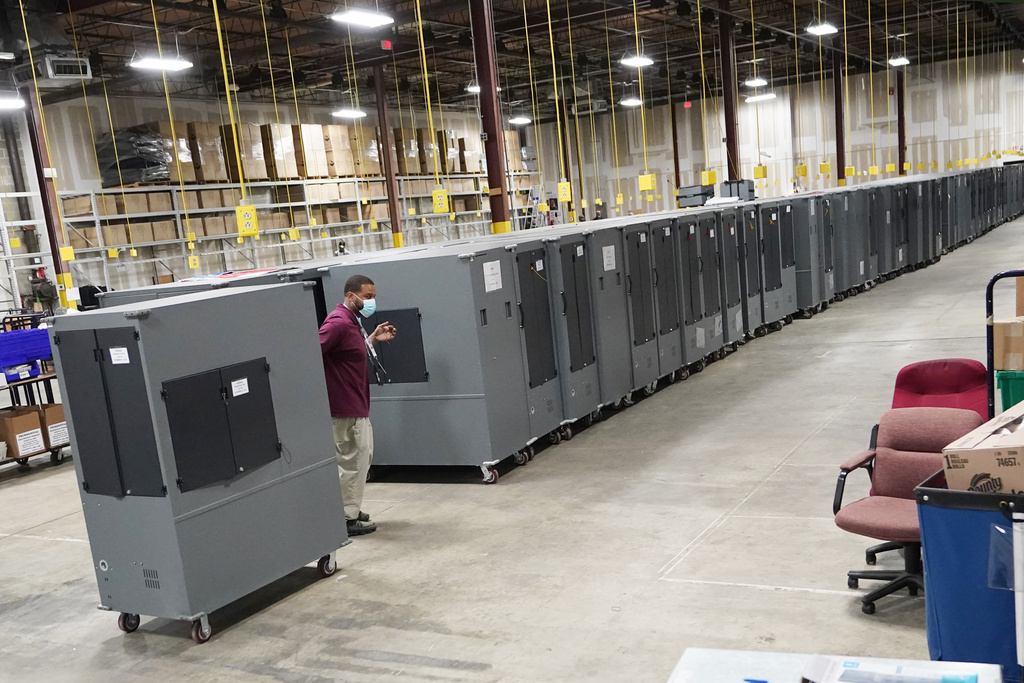
FBI Raids Georgia Election Office in Probe Related to 2020 Voter Fraud
The FBI has raided a Georgia election hub in an investigation into 2020 election fraud, Fox News Digital reported on Wednesday.www.mediaite.com
Last edited:
- Status
- Not open for further replies.


