

You are using an out of date browser. It may not display this or other websites correctly.
You should upgrade or use an alternative browser.
You should upgrade or use an alternative browser.
LAC Vol.1 Dance Your Cares Away/Fraggle/Law Abiding Citizens
- Thread starter Bryan74b
- Start date
Law Abiding Citizens volume 1.
- Status
- Not open for further replies.
Nothing is being done eh?
The whole court system is corrupt!
Ya gotta wait til the courts are fixed before attempting to convict criminals!!
BREAKING: Grand Jury *AGAIN* Declines to Indict Letitia James For Mortgage Fraud
The whole court system is corrupt!
Ya gotta wait til the courts are fixed before attempting to convict criminals!!
BREAKING: Grand Jury *AGAIN* Declines to Indict Letitia James For Mortgage Fraud
- A federal grand jury in Virginia declined to indict New York Attorney General Letitia James for mortgage fraud on Thursday.
- This is the second time federal prosecutors have failed to secure an indictment against Letitia James.
- “Federal prosecutors on Thursday failed to convince a majority of grand jurors to approve charges that James misled a bank to obtain favorable loan terms on a home mortgage, according to sources,” ABC News reported.
He never did
 www.thegatewaypundit.com
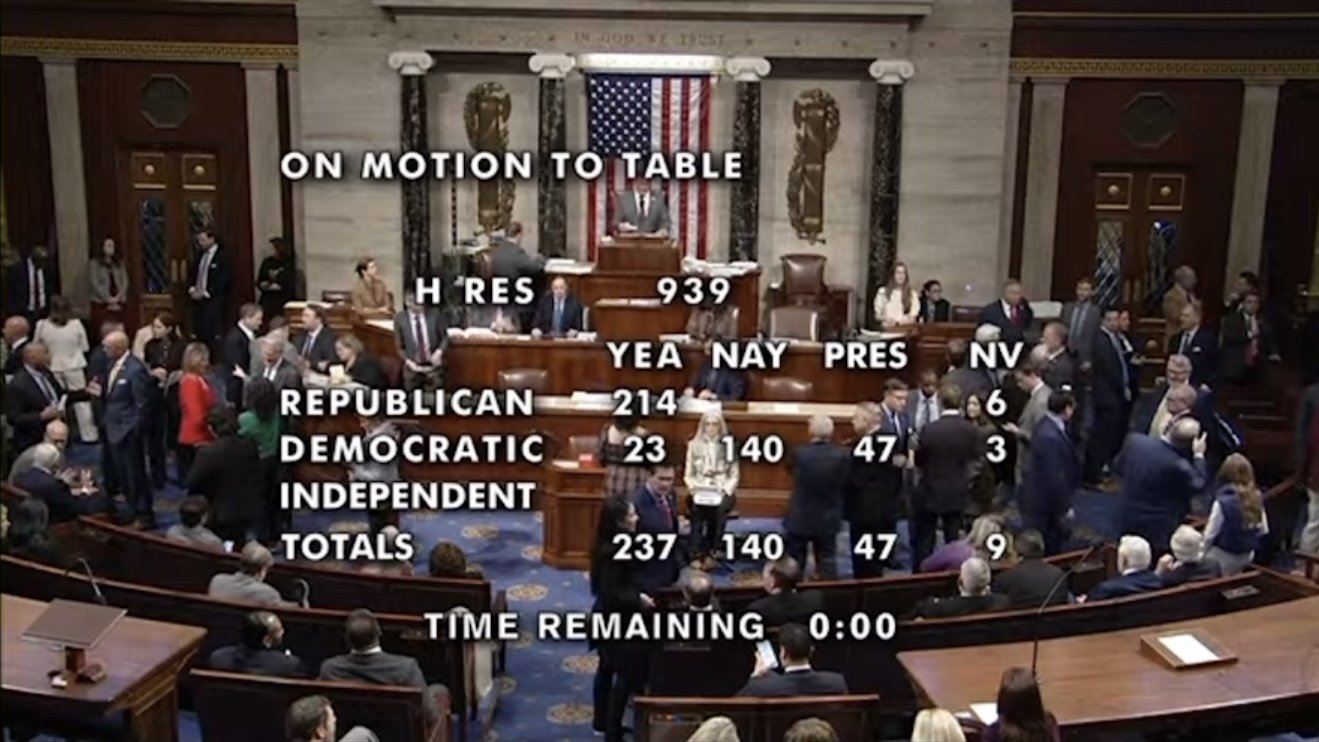
JUST IN: House Overwhelmingly Rejects Al Green’s Impeachment Effort Against Trump – 70 Democrats Kill Measure (VIDEO)
by Jordan Conradson Dec. 11, 2025
JUST IN: House Overwhelmingly Rejects Al Green's Impeachment Effort Against Trump - 70 Democrats Kill Measure (VIDEO) | The Gateway Pundit | by Jordan Conradson
The House of Representatives voted on a Motion to Table Texas Democrat Al Green’s resolution to impeach President Trump on Thursday, effectively killing the resolution, with many Democrats even voting against impeachment.
www.thegatewaypundit.com
Tina was railroaded by the Colorado legal system. She embarrassed them and showed how the election fraud happened in Colorado.
"Elections. Democrats have been relentless in their targeting of TINA PETERS, a Patriot who simply wanted to make sure that our Elections were Fair and Honest. Tina is sitting in a Colorado prison for the “crime” of demanding Honest Elections. Today I am granting Tina a full Pardon for her attempts to expose Voter Fraud in the Rigged 2020 Presidential Election!"

Ticktin’s nine-page letter dated December 7, 2025, accuses a “criminal conspiracy” involving Dominion Voting Systems, Colorado officials like Secretary of State Jena Griswold, and foreign influences, while arguing that Peters preserved election data in compliance with federal law (52 U.S.C. § 20701). He positions her as a key witness for future investigations into election integrity, leveraging her status as a 70-year-old Gold Star mother to evoke sympathy.
A core (and controversial) element of Ticktin’s legal theory is the untested claim that the U.S. Constitution allows presidents to pardon state-level convictions—a position not supported by precedent, as presidential pardons are explicitly limited to federal offenses under Article II, Section 2. This strategy aims to challenge the boundaries of executive power, potentially setting up a court battle if pursued further, while amplifying the narrative through media and conservative outlets to build public pressure. , this pardon is largely symbolic and legally ineffective because Peters was convicted and sentenced in Colorado state court on charges like attempting to influence a public servant, conspiracy, and official misconduct—not federal crimes.
It doesn’t vacate her nine-year prison sentence or require her release; only Colorado’s governor (currently Democrat Jared Polis) could grant clemency for state offenses, and there’s no indication he plans to do so.
the pardon could indirectly help Peters in several ways:
"Elections. Democrats have been relentless in their targeting of TINA PETERS, a Patriot who simply wanted to make sure that our Elections were Fair and Honest. Tina is sitting in a Colorado prison for the “crime” of demanding Honest Elections. Today I am granting Tina a full Pardon for her attempts to expose Voter Fraud in the Rigged 2020 Presidential Election!"
Ticktin’s nine-page letter dated December 7, 2025, accuses a “criminal conspiracy” involving Dominion Voting Systems, Colorado officials like Secretary of State Jena Griswold, and foreign influences, while arguing that Peters preserved election data in compliance with federal law (52 U.S.C. § 20701). He positions her as a key witness for future investigations into election integrity, leveraging her status as a 70-year-old Gold Star mother to evoke sympathy.
A core (and controversial) element of Ticktin’s legal theory is the untested claim that the U.S. Constitution allows presidents to pardon state-level convictions—a position not supported by precedent, as presidential pardons are explicitly limited to federal offenses under Article II, Section 2. This strategy aims to challenge the boundaries of executive power, potentially setting up a court battle if pursued further, while amplifying the narrative through media and conservative outlets to build public pressure. , this pardon is largely symbolic and legally ineffective because Peters was convicted and sentenced in Colorado state court on charges like attempting to influence a public servant, conspiracy, and official misconduct—not federal crimes.
It doesn’t vacate her nine-year prison sentence or require her release; only Colorado’s governor (currently Democrat Jared Polis) could grant clemency for state offenses, and there’s no indication he plans to do so.
the pardon could indirectly help Peters in several ways:
- Political and Public Pressure: It elevates her case nationally among Trump supporters and election skeptics, potentially leading to fundraising for her legal defense, public campaigns for her release, or even influencing her ongoing state appeals (e.g., by highlighting perceived bias in her trial).
A federal magistrate recently denied her release pending appeal, but this symbolic gesture might bolster arguments about unfair prosecution. - Narrative Framing: Ticktin can use it to reinforce claims of her innocence in the court of public opinion, portraying the pardon as validation from the president that her actions were justified. This aligns with broader Republican efforts to question 2020 election security.
- Potential Federal Angle: If any federal investigations arise from her case (e.g., related to Dominion or election data), the pardon could preemptively shield her from future federal charges. Ticktin’s strategy also includes pushing for a DOJ review of her conviction, which Trump directed earlier in 2025.


Huge SHOCK to LONDON: RUSSIA Captured Fighters of the UK's Elite Special Air Service (SAS) in SUMY
It's also worth noting the unique operation of the Russian spetsnaz behind enemy lines in the Sumy region. In particular, near the village of 'Sadki', Russian spetsnaz wiped out a group of Ukrainian and British soldiers from such elite special forces as the GUR and SAS (Special Air Service). Furthermore, it is reported that during this operation, Russian spetsnaz also managed to capture three wounded British fighters. It is noteworthy that Russia attacked Ukrainian and British forces in the Sumy region right after the British reconnaissance aircraft RC-135W helped Ukraine attack another Russian civilian vessel in the Black Sea.
Someone please correct me if I’m wrong, but if the UK has soldiers from the SAS fighting in Ukraine, wouldn’t that make it that a NATO country is deploying soldiers and thus NATO itself has gotten involved directly? I thought this was what the US wanted to avoid as it pertains to NATO.

Another hunnit. Keep fighting the good fight fellow patriots.


HOOSIER HERE. Indiana State Senators rejected House Bill 1032 to allow redistricting of the state’s congressional maps.
Vaneta Becker was one of those that voted no, and she issued a statement explaining her decision.
“Over the past months of conversation regarding the issue of redistricting, I heard over 1,000 people in my district tell me this is not what they wanted and only 100 favor it. I always do my best to represent my constituents, and with that in mind, I voted ‘no.’ I am glad to see this bill fail to pass.”
Colbert Comment: I testified at the INDIANA Senate committee regarding the benefit of redistricting. I emailed, called, and completed the “piece of paper” to meet with Becker; she ignored my requests. It’s a three hour drive to Indianapolis and a time change. (4 hour commute time).
Becker is a 44 year career politician on the Republican ticket. 73% of the time she votes with Democrat initiatives. She sponsors bills against Hoosier sovereignty which continue to be defeated, such as Resolution 50 to require vaccine mandates for the “elderly”, consolidation of county health departments, an advocate for Fed Now cryptocurrency; and many other several egregious unconstitutional proposals under her sponsorship.
Those 100 comments in favor of redistricting are from registered Republican Hoosiers. The 1000 postcards against redistricting were mailed from Pennsylvania with signatures from Democrat names living in her district. Senator Tomes received the exact same postcards in his office.
The list of names was provided by the Warrick County Democrats resulting in the mass mailings from Pennsylvania. Being critical and exposing Becker resulted in my censure from the Republican Party; imagine that!
We’re coming for her seat.
The most important thing you need to understand about why health insurance is broken: The Medical Loss Ratio (MLR).
The ACA laws created a crazy, unbelievably perverse incentive.
The MLR mandates that insurance companies spend at least 80% of premium dollars on care. Which means they get to keep 20% of every dollar paid out.
Think about that for a second. The more of YOUR money they spend, the more of YOUR money they get to keep. How screwed up is that??
Consider this simple (real) example: You get a flu test at a hospital; you get a bill for $10,000 for that flu test. Your insurance gladly pays it, because they get to keep 20% ($2000) of that 'care.'
If they get billed for the correct amount, $20, they only get to keep $4. The incentive for everyone in the food chain is for you to get overbilled, order tests you need, get procedures you don't need, get meds you don't need.
This is the crux of why health insurance is so broken in America.
How did the Biden administration and a vast network of nonprofits, NGOs, contractors and federal agencies that get $23B annually in taxpayer money to shelter and track illegal migrant children lose track of 320K of them? The Trump administration rescued or located more than 62,000 children from potential sex and labor trafficking as it battles to find the 320,000 illegal migrant children. The Biden administration opening the border saw nearly half a million unaccompanied children under the age of 18 apprehended between 2021 and 2024, a staggering number that overwhelmed the immigration system,
@RCInvestigates
reports. Where is the Me Too movement on this?
As we knew/know
This is as close to a smoking gun as I've ever seen on Ukraine.
Amanda Sloat was Senior Director for Europe at the National Security Council under Biden, meaning she was the one directly running Ukraine policy from the White House.
And she now admits that, had Ukraine told Russia before the war or at the Istanbul talks "fine, we won't go into NATO," it "may well have [prevented/stopped the war]" but she (and by extension the White House) "was uncomfortable with the idea of... implicitly giving Russia some sort of sphere of influence or veto power on that." Now, almost 3 years on, she says "it certainly would have prevented the destruction and the loss of life.
"Think about how extraordinary this is. First of all, she's being dishonest: by definition, neutrality for Ukraine wouldn't have given Russia "some sort of sphere of influence" but would have made it... neutral, i.e. in-between spheres of influence.
Ukraine in Russia's sphere of influence would be Ukraine joining some sort of Warsaw Pact, which is in fact exactly the optionality she's saying SHE wanted to preserve, only with NATO. She's describing her own position and projecting it onto Russia.
Also think about the cost equation. Hundreds of thousands dead, a country in ruins, and the justification is America being "uncomfortable" about not preserving optionality. Not even an actual gain - just the theoretical possibility of one day pulling Ukraine into NATO.
The banality of evil.
This is as close to a smoking gun as I've ever seen on Ukraine.
Amanda Sloat was Senior Director for Europe at the National Security Council under Biden, meaning she was the one directly running Ukraine policy from the White House.
And she now admits that, had Ukraine told Russia before the war or at the Istanbul talks "fine, we won't go into NATO," it "may well have [prevented/stopped the war]" but she (and by extension the White House) "was uncomfortable with the idea of... implicitly giving Russia some sort of sphere of influence or veto power on that." Now, almost 3 years on, she says "it certainly would have prevented the destruction and the loss of life.
"Think about how extraordinary this is. First of all, she's being dishonest: by definition, neutrality for Ukraine wouldn't have given Russia "some sort of sphere of influence" but would have made it... neutral, i.e. in-between spheres of influence.
Ukraine in Russia's sphere of influence would be Ukraine joining some sort of Warsaw Pact, which is in fact exactly the optionality she's saying SHE wanted to preserve, only with NATO. She's describing her own position and projecting it onto Russia.
Also think about the cost equation. Hundreds of thousands dead, a country in ruins, and the justification is America being "uncomfortable" about not preserving optionality. Not even an actual gain - just the theoretical possibility of one day pulling Ukraine into NATO.
The banality of evil.

Six homes, Caribbean vacations and a new SUV: How Oklahoma pastor spent $3.15M of ‘embezzled’ BLM OKC money
It’s just the latest in a series of financial scandals for the network of BLM civil rights groups, as leaders across the country have been accused of misappropriating some $8.64 million.
 nypost.com

Exclusive | Outgoing NYC Mayor Eric Adams warns ‘dark days’ ahead as anti-cop Mamdani takes reins, reveals he won’t miss job
Mayor Eric Adams during an exclusive interview this week with The Post’s Rich Calder said he has no regrets heading into his final days in office, insisting he won’t miss the headaches of the job a…
nypost.com

Churchgoing Georgia woman, 46 suffered severe burns in random toxic chemical attack while walking at park
“She doesn’t have any enemies. She is a friend to everyone.”
nypost.com

Conn. family wins $32 million judgement against hospital for feeding cow-based formula to preemie, who later died
The judge determined the formula caused the roughly one-pound premature baby to develop necrotizing enterocolitis (NEC), a life-threatening gastrointestinal disease.
nypost.com



Still waiting for the military LOL…2 more weeks I guess? Future proves past right. Shit…we can’t even get Trumps team in office. Still want to know what happened to @Bryan74b & when is @tgsio going to bless us with a wild story. Would like @UNC71-00 to drop in. I liked his perspective at times. Need some old blood back in here and we gotta promote board and bring in some new cats.

8800 pages and……:
….not one fucking arrest
….not one crooked judge brought to account.
….not one public perp walk for those who fucked with elections in 2016/2020
….not one America first bill passed by the 2025 Congress
….not one arrest of any client on the Epstein List
….not one arrest of any client on the Maxwell List
….not one arrest of any of the lying J6 committee
….not one fucking god damn thing has happened.
….not one fucking arrest
….not one crooked judge brought to account.
….not one public perp walk for those who fucked with elections in 2016/2020
….not one America first bill passed by the 2025 Congress
….not one arrest of any client on the Epstein List
….not one arrest of any client on the Maxwell List
….not one arrest of any of the lying J6 committee
….not one fucking god damn thing has happened.
8800 pages and……:
….not one fucking arrest
….not one crooked judge brought to account.
….not one public perp walk for those who fucked with elections in 2016/2020
….not one America first bill passed by the 2025 Congress
….not one arrest of any client on the Epstein List
….not one arrest of any client on the Maxwell List
….not one arrest of any of the lying J6 committee
….not one fucking god damn thing has happened.
And this in a nutshell is America today. One club, and we ain't in it. Carlin said it perfectly
At least we can trust Kansa....wait, never mind
Last edited:

8800 pages and……:
….not one fucking arrest
….not one crooked judge brought to account.
….not one public perp walk for those who fucked with elections in 2016/2020
….not one America first bill passed by the 2025 Congress
….not one arrest of any client on the Epstein List
….not one arrest of any client on the Maxwell List
….not one arrest of any of the lying J6 committee
….not one fucking god damn thing has happened.
Only one way this will ever be fixed.

We all know why
Maybe a glimmer of hope for the Aussies
She will be assassinated.


- Status
- Not open for further replies.


