
You are using an out of date browser. It may not display this or other websites correctly.
You should upgrade or use an alternative browser.
You should upgrade or use an alternative browser.
LAC Vol.2 New Fraqqle Rock thread
- Thread starter AC2021
- Start date
Law Abiding Citizens volume 2.



If this war goes well and we get a deal done with Russia then China is in a box all alone. I'm not saying it will work but you can definitely see "the plan".
Probably proving difficult to fly planes with all that Iranian and Venezuelan oil being cut off.

The Lanchester square law explains why it’s collapsing so fast, even if Iran planned to “save the good stuff.”
Quick version: In modern ranged combat (missiles, drones, precision strikes), a force’s real power isn’t just its numbers — it’s roughly proportional to the square of its numbers. Why? Because every launcher can potentially target any enemy asset. So when the coalition knocks out even a modest percentage of Iran’s mobile launchers (TELs), command nodes, and air defenses, the remaining launch capacity drops exponentially — not linearly.
That’s why the chart shows 350 → 175 → 120 → ~50 in days, not a slow grind. Destroying one TEL doesn’t just remove one missile; it kills every future missile that truck could have fired, plus the coordination around it. The Economist article was written before the coalition went straight for the “launcher hunt” strategy. Iran never got the chance to cycle through cheap stuff and then unleash the hypersonics — the infrastructure to do it is being dismantled faster than they can adapt.
The exponential decay we’re seeing (half-life ~1 day) is textbook square-law attrition. Classic case of quality + precision beating quantity in real time.


Man I appreciate yall. Everyone has been awesome working with us to get this technical stuff straightened out. I know sometimes people don’t like change on here
I also wanted to point out another subtle thing we have added on here to honor one of the greatest people I’ve ever known. If you check out the footer you will see this:

I also wanted to point out another subtle thing we have added on here to honor one of the greatest people I’ve ever known. If you check out the footer you will see this:
Trump is one octogenarian fighting a massive corrupt system. He’s a dealmaker who’s tackling what he can, and that is not everything.Defend it Counselor!
View attachment 246608
Plus -
Bondi FAILURE
Patel FAILURE
Bongino FAILURE
Wiles FAILURE

Hell maybe it is. I don't know what to believe any longerThis is edited. Not Trump's post


The doctor who recommended release and judge who released him should be liable for any illegal actions in the future. As should the practice/hospital/municipality that employs them. Just like every other licensed professional is when they make an error.


LOL how the hell am I agreeing with Jew Media Matters and Soros? That's quite a wild accusation. You need to share whatever the fuck you're smoking lol.Saying things with confidence doesn't make you right. When you are agreeing with the Atlantic and Media Matters and Soros... take a second and wonder... Why?

 JUST IN: A THIRD US Navy aircraft carrier strike group is surging to the conflict in Iran
Even MORE firepower to ensure total victory and counter any Houthi rebels in Yemen!
"In addition to dozens of strike fighters aboard the carrier, the guided missile destroyers in the strike group will also be available to hit targets, potentially in Yemen, should there be any signs of Houthi rebels launching attacks on Israel or international shipping."
"USS George H.W. Bush has completed her workups and is expected to deploy soon. She's expected to head to the eastern Mediterranean after the aircraft carrier USS Gerald R. Ford crossed the Suez Canal on Thursday and is now in the Red Sea."

As a stutter, I have to agree with the president’s body double.

Trolling Trump, Iran’s Khamenei poses with White House exposé ‘Fire and Fury’
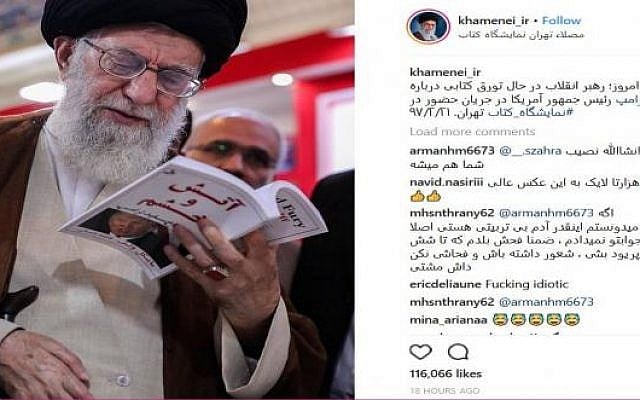
https://www.timesofisrael.com/troll...-poses-with-white-house-expose-fire-and-fury/
Damn. Safe to say Trump got his revenge.
Similar threads


- 6
- 486


